
Research News
Stem Cell Medicine Put to the Test:
Eight Countries Compared
Germany takes first place in the regulation of stem cell medicine. Stem cell treatments are sold commercially in dozens of countries, at prices that commonly run into five figures. The legal regimes behind them differ far more than the marketing does. We asked four questions that any patient can put to any clinic, and applied them to eight jurisdictions. Germany is the only one that answers all four.
In short: We scored eight countries on four questions: who licenses and inspects manufacture, whether the product itself is assessed, who releases each batch, and whether harm must be reported. Germany answers all four, Japan three. The comparison concerns legal frameworks, not individual clinics, and it says nothing about whether a treatment works.
Patient information · Read time: about 24 minutes
| Component | Detail |
|---|---|
| Two products | Bone Marrow Concentrate (BMC) and Mesenchymal Stem Cell Secretome (MSEC), each manufactured under official authorisation; no marketing authorisation (experimental) |
| Authorisations | BMC § 20b / § 13 AMG · MSEC § 20b / § 20c AMG (German Medicines Act) |
| Location | Offenbach am Main, Germany |
The result
Scored against the four questions on this page, and against nothing else. A question counts as answered only where the framework answers it in full; partial coverage does not count. Each mark refers to the legal framework of the country, not to any individual clinic within it.
| Country | 1 — Manufacture licensed by a named authority and inspected | 2 — Product itself assessed by a regulator | 3 — Named person legally responsible for releasing each batch | 4 — Mandatory adverse-event reporting to a public authority | Questions answered |
|---|---|---|---|---|---|
| Germany | Yes | Yes | Yes | Yes | 4 of 4 |
| Japan | Yes | Conditional | Not in this form | Yes | 3 of 4 |
| India | Partly | No | Partly | Partly | 0 of 4 |
| United States | Registration only | No | No | Partly | 0 of 4 |
| Panama | Partly | No | No | No | 0 of 4 |
| Thailand | Partly | No | No | No | 0 of 4 |
| Mexico | Partly | No | No | No | 0 of 4 |
| Costa Rica | No | No | No | No | 0 of 4 |
Germany answers all four
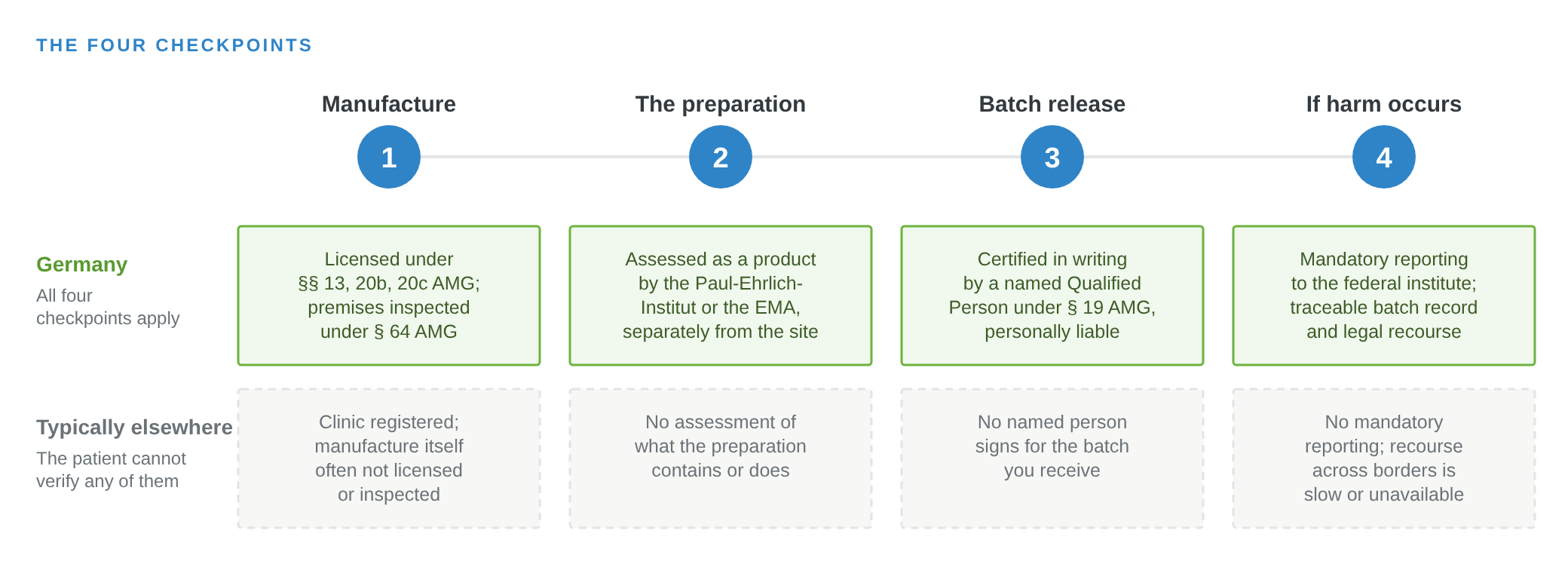
Germany is the only country in this comparison that does. Manufacture is licensed by a named authority and inspected under § 64 AMG. The product is assessed separately from the premises, by the Paul-Ehrlich-Institut or the European Medicines Agency. Every batch is released in writing by a named Qualified Person who is personally liable for that signature. Adverse events must be reported to the federal institute. Germany is also one of only two EU member states that publishes the authorised products together with their product information.
Japan comes closest, and deserves the credit
It is the only other country here that regulates cell-processing facilities for ordinary clinical practice rather than only for trials. It is also the only one outside Europe with a product assessment route at all. Its conditional approval pathway is a serious attempt to reach patients faster without abandoning oversight. When one conditionally approved product failed to demonstrate efficacy in 2024, the ministry refused to convert it to full approval. That is a regulator doing its job. The gap is that approval can precede proof, and that the responsibility for an individual batch is not attached to a single named person in the way European law requires.
Everywhere else, the first three questions have no answer
That is not a judgement about the physicians working in those countries. It is a statement about what a patient is able to verify before travelling. In most of these jurisdictions, that is the licence of the building and very little else.
One thing this scoring does not measure, and cannot. A framework that answers all four tells you that what you receive has been manufactured under licence, assessed by a regulator, released by a person who signed for it, and traced if it causes harm. It does not tell you that the treatment will work. No regulator in any country certifies that, and anyone who tells you otherwise has misunderstood what a marketing authorisation is.
How we arrived at that result
The method is deliberately narrow. Four questions, each with a factual answer that a provider can give in a sentence or cannot give at all. They are applied to the law of each country rather than to the reputation of any clinic within it.
Question 1 — Who licensed the manufacture, and who inspects it?
A clinic may be registered to treat patients and still have no authorisation to manufacture what it injects. These are two different permissions from two different authorities. Ask which authority issued the manufacturing licence, under which legal provision, and when the facility was last inspected. A licence number you can check against a public register is worth more than any certificate on a wall.
Question 2 — Has the product been assessed, or only the premises?
A clean room is not a medicine. Cell preparations can be made in an inspected facility and still never have been assessed for what they contain or what they do. Ask whether the preparation itself has been through a regulatory assessment, and under what status it is supplied: approved medicinal product, hospital exemption, named-patient supply, or clinical trial. Each of these means something different, and a clinic that cannot name which one applies is telling you something.
Question 3 — What exactly is being injected, and who released the batch?
“Stem cells” is not a specification. Ask which cell type, from which source, at what dose, expanded over how many passages, and tested for what: sterility, endotoxin, mycoplasma, viability, identity. Then ask who signs the release of each batch and what qualification that person holds. In the EU this is a named Qualified Person with personal legal responsibility. Elsewhere the answer is sometimes that nobody does.
Question 4 — What happens if something goes wrong?
Ask where adverse events are reported and to whom, whether the clinic is obliged to report them, and what liability cover exists. Then ask what recourse you have from your home country. Litigation across borders is slow, expensive and frequently pointless. This is the question patients ask last and should ask first.
The countries in detail
What follows describes legal frameworks, not the quality of individual clinics. A country with a weak framework may still contain careful physicians, and a strong framework is no guarantee that a given treatment will work. The point of the table is narrower: it shows what you are able to verify for yourself before you travel.
| Country | Regulator and legal basis | Manufacture licensed and inspected? | Is the product itself approved? | What you can check yourself |
|---|---|---|---|---|
| United States | FDA. Public Health Service Act § 361 vs § 351; 21 CFR Part 1271 | Registration only, for most clinics. Registering a tissue establishment is not approval, and the FDA says so in terms | Not for the usual offers. The first mesenchymal stem cell therapy was approved only in December 2024, for one narrow paediatric indication. No approved adipose, exosome or amniotic product exists for orthopaedic, neurological, autism or anti-ageing use | FDA establishment registration database; the list of licensed cell and gene products; published warning letters. A listing on ClinicalTrials.gov proves nothing about legality; again, the FDA says so |
| Mexico | COFEPRIS. General Health Act, Title 14, Art. 315 | Establishments are licensed, in three categories. But no Norma Oficial Mexicana governs the therapies themselves, despite calls since 2015 | No. The rules cover collection facilities and biobanks, not clinical application | Yes, and it is worth doing. COFEPRIS publishes the official list of licensed regenerative-medicine establishments. One study of Tijuana clinics found thirteen claiming a licence; on checking, only one matched the register for both name and address |
| Panama | Ministry of Health. Law No. 3 of 2010; Executive Decree No. 179 of 2018 | Licence required for extraction and transplantation of anatomical components | No. The 2018 decree follows ISSCR guidance: only haematopoietic transplantation for blood disease is accepted practice; everything else is experimental | Yes. Exactly four centres hold an active licence, all for haematopoietic stem cells, and all four are named in the published literature. A 2026 survey found six further businesses marketing unproven treatments at $5,000 to $50,000, none of them licensed for it |
| Thailand | Thai FDA; Department of Health Service Support; Medical Council of Thailand (2011 rule) | Facilities are licensed. But autologous cells have not been treated as drugs under the Thai Drug Act, so the Thai FDA has not assessed them | Only two exceptions: haematopoietic stem cells for blood disease, and cultivated corneal epithelial cells for limbal stem cell deficiency | Under the 2011 Medical Council rule, any procedure placing stem cells in the body counts as research and needs ethics committee approval; a doctor who ignores this risks their licence. A Cell Therapy Act has been drafted but was still not in force at the last published account |
| Costa Rica | Ministry of Health. No framework specific to cell therapies identified | No separate manufacturing licence for cell preparations could be identified | No | The precedent is instructive. The country’s largest stem cell clinic held a permit to store cells but not to administer them; the ministry halted it in 2010. It reappeared in Panama in 2013, having previously operated in India and Mexico, a pattern worth knowing about |
| Japan | MHLW and PMDA. Act on the Safety of Regenerative Medicine, and the PMD Act, both in force since November 2014 | Yes, and unusually so. Japan regulates cell-processing facilities for ordinary clinical practice, not only for trials. Plans go to a certified committee and to the ministry | Conditionally. A product can reach the market on early-phase data, with a time limit and a requirement to prove itself afterwards | The ministry’s public register of submitted treatment and research plans. Note the proportions: as of 2023 there were 3,868 higher-risk treatment protocols against 48 higher-risk research protocols |
| Germany | Regional authority for the facility; Paul-Ehrlich-Institut for the product. §§ 13, 20b, 20c, 21a, 4b and 64 of the Medicinal Products Act (AMG) | Yes. Manufacture requires a licence from the state authority, granted in concert with the federal institute, and the premises are inspected under § 64 AMG. A named Qualified Person must certify every batch in writing before release, personally | A separate question, and the one to press on. § 21a covers only haematopoietic stem cells for restoring blood formation. An advanced therapy supplied to others needs either a European marketing authorisation or a specific national authorisation under § 4b(3). A preparation made and given in-house to the clinic’s own patients needs no marketing authorisation, but still the manufacturing authorisation, in which the Paul-Ehrlich-Institut is involved | Yes. EudraGMDP lists manufacturing authorisations and GMP certificates across the EU. Germany is one of only two member states that publishes the authorised products together with their product information |
| India | CDSCO. Drugs and Cosmetics Act 1940; New Drugs and Clinical Trials Rules 2019 | Manufacture is licensed by state drug authorities. The national stem cell research guidelines are not legally enforceable | Essentially no. Haematopoietic transplantation, plus one licensed product for last-line critical limb ischaemia. Everything else belongs in a trial | Clinical Trials Registry India: registration has been mandatory before first enrolment since 2018 |
Countries sometimes named in this context (the Cayman Islands, Ukraine, Russia, the Bahamas) are left out because no authoritative, current regulatory source could be identified for them. That absence is itself worth knowing before you travel to one.
Japan shows that the choice is not between speed and safety
It is the most interesting case, and it cuts against the simple story.
Since 2014 Japan has run a system no one else has. Cell preparations used in ordinary clinical practice, not only in trials, must be made in a regulated facility. The treatment plan must be reviewed by a certified committee and filed with the ministry. Alongside it sits a conditional approval route that lets a product reach the market on early-phase evidence, with a time limit attached.
That design was meant to get regenerative medicine to patients faster without abandoning oversight. It has been heavily criticised by researchers, including Japanese ones. One product was conditionally approved on data from seven patients. Review committees have been found to sit too close to the institutions they review. And the therapy track has filled up far faster than the research track.
But the conditional route did something the critics may not have expected. In July 2024 the ministry examined the post-marketing data for that seven-patient product, concluded it had not demonstrated efficacy, and refused to convert it to full approval. A regulator took a product off its own fast lane.
That is the point worth taking from Japan. Regulation is not the opposite of access. It is the thing that decides, afterwards, whether what you were given actually worked, and tells you so.
What a German manufacturing licence actually involves
We set this out at length because it is the part most often invoked and least often explained. The distinctions inside it matter more than the word “regulated”.
German law separates permissions that elsewhere are blurred together. A licence to run a clinic is not a licence to manufacture. A licence to manufacture is not an approval of the product. And an approval of one product says nothing about the next.
The facility
Manufacturing medicinal products requires a licence under § 13 AMG. Procuring human tissue and performing the laboratory tests on it requires a separate licence under § 20b AMG. Processing, preserving, testing, storing or placing tissue preparations on the market requires another under § 20c AMG, granted by the authority of the federal state in concert with the Paul-Ehrlich-Institut. Each is refused unless the premises are suitable, the staff are qualified, a quality management system is in place, and the work follows the current state of science. Under § 64 AMG the facility is then subject to official inspection, with federal experts brought in for advanced therapies.
The person
A licence requires a named Qualified Person with a defined degree and at least two years of practical analytical experience. Under § 19 AMG that individual must certify, for every single batch, in a continuous register, that it was manufactured and tested according to the rules, before it may be released. The responsibility is personal and it attaches to a name. This is the answer to the third of our four questions, and in many countries there is no equivalent answer at all.
The product: where the real distinction lies
None of the above says a word about whether a preparation works. Product authorisation is a separate track, and it is tied to one act: placing a preparation on the market, or supplying it to others. § 21a AMG covers tissue preparations whose effects are already established in the scientific literature. The Paul-Ehrlich-Institut states plainly what that amounts to in practice: haematopoietic stem cells from bone marrow, peripheral blood or cord blood, for restoring blood formation. Nothing else. An advanced therapy medicinal product that is supplied to others requires either a European marketing authorisation or a specific national authorisation under § 4b(3) AMG, which demands a dossier including pharmacological and toxicological data, a benefit–risk assessment and a risk management plan.
As of the most recent published survey, ten products held such a national authorisation in Germany. Not ten thousand. Ten.
There is a third case, and it is the route ANOVA’s own preparations take. A preparation made in-house for an individual patient, and given there under a physician’s responsibility, is not placed on the market. It needs no marketing authorisation, but it still needs the manufacturing authorisation, the inspections and the named person who releases each batch. The Paul-Ehrlich-Institut is involved in granting that authorisation, reviews the preparation as part of it and takes part in the inspections. What such a preparation does not have is a regulator’s finding that it works; that can only come from clinical trials.
Why the structure matters more than the word “regulated”
Almost every country in the table can say, accurately, that stem cell treatment there is regulated. What differs is what the regulation reaches. German law places a separate requirement at each of the three points where something can go wrong: the facility, the person who releases the batch, and the preparation itself. Each one is independently verifiable from outside. That is the difference between a framework that governs the practice and one that merely registers it.
What the literature records
Documented cases from peer-reviewed journals and regulatory records, not anecdotes. They are summarised briefly because the point is not the detail of any one case but what all of them have in common.
- Serious vision loss after injections for macular degeneration, 2017. Three patients at one clinic received fat-derived “stem cells” into both eyes. All three lost substantial vision. New England Journal of Medicine.
- A spinal cord lesion after treatment in three countries, 2016. A patient who had received intrathecal stem cell injections abroad developed a growing mass in the spinal cord. New England Journal of Medicine.
- Twelve patients infected from one contaminated product, 2018. Umbilical cord blood preparations distributed in the United States were found to carry bacterial contamination; all twelve recipients required hospital treatment. The US Centers for Disease Control noted that the companies involved were registered with the FDA, and that registration is not approval. This is question one and question three, in a single case.
- A tumour derived from the donor cells, 2009. A patient treated abroad with fetal neural stem cell injections later developed a multifocal tumour. Genetic analysis showed it originated from the donated cells rather than the patient’s own. PLoS Medicine.
- Tissue growths at the injection site, 2010. A patient given her own blood stem cells injected directly into a kidney developed masses at the injection sites that required surgery. The pathology was a lesion not previously described. Journal of the American Society of Nephrology.
These are not typical outcomes, and they are not on their own a reason to prefer one country over another. They are included because they share a single feature: in each case the preparation was given without any authority having assessed what it contained or what it would do. That is the gap the four questions are designed to find.
Frequently asked questions
Questions patients ask us about stem cell treatment abroad, answered at the level of what can be verified.
What is the difference between a clinic licence and a manufacturing licence?
They are issued by different authorities for different things, and conflating them is the single most common misunderstanding in this field. A clinic licence permits the treatment of patients on those premises. A manufacturing licence permits the production of the preparation that is injected. A clinic may hold the first and not the second. Then the thing being injected has been made somewhere, by someone, under conditions nobody has examined.
A clinic says it is “FDA-registered”. What does that actually mean?
It means the establishment has filed its existence with the FDA, which is a form submission, not an assessment. The FDA states in its own patient guidance that registration and listing do not constitute approval and that firms should not represent it as such. If a clinic’s strongest regulatory claim is registration, that tells you the product has not been reviewed.
The clinic’s treatment is listed on ClinicalTrials.gov. Is that an approval?
No. Registration on that database is largely self-reported and does not mean the study has been reviewed or authorised by the FDA. Some unapproved commercial treatments have been listed there while patients were being charged to take part. That is itself a signal worth noticing, since participants in a properly regulated trial do not usually pay for the intervention.
What is a Qualified Person, and why does it matter so much?
It is the named individual who must certify every batch before release, and it matters because responsibility then attaches to a person who can be held to account. Under § 19 AMG that person holds a defined qualification and at least two years of practical analytical experience. They record, in a continuous register, that the batch was manufactured and tested according to the rules. In much of the world no equivalent signature exists, and the honest answer to “who released this batch?” is nobody.
Is a treatment using my own cells less regulated, or safer?
Less regulated in some countries, which is a different claim from safer. Autologous origin removes the risk of immune rejection and of transmitting a donor’s disease. It does not remove the risks that come from processing: contamination during handling, the behaviour of cells after expansion, and the consequences of injecting them into a site they do not belong in. Several of the documented harms on this page involved patients’ own cells. More on autologous and donor cells.
Why are stem cell treatments so much cheaper abroad?
Partly lower operating costs, and partly because the steps that cost money in a regulated system are not being carried out: licensed manufacture, product assessment, release testing, batch documentation, pharmacovigilance. A price difference of that kind is not a bargain so much as an itemised list of what has been left out.
Can I check a stem cell clinic’s licence myself before I travel?
In several countries, yes, and it is worth the hour it takes. The EU publishes manufacturing authorisations and GMP certificates in EudraGMDP. Mexico’s COFEPRIS publishes the official list of licensed regenerative-medicine establishments. The FDA publishes its establishment registrations, its list of licensed cell and gene therapy products, and its warning letters. Japan’s ministry publishes submitted treatment plans. Check the name and the address against the register, not just the name.
What does Japan’s “conditional approval” mean?
It allows a product onto the market on the strength of early-phase data showing safety and probable benefit, with a time limit and an obligation to demonstrate efficacy afterwards. It is a genuine assessment, not a formality, and it can end in refusal. In July 2024 the ministry declined to convert one conditionally approved cardiac product to full approval after its post-marketing data failed to demonstrate efficacy.
Does an approval ever get withdrawn?
Yes, and it is a sign the system works rather than a sign it does not. Alofisel, an allogeneic stem cell therapy authorised in the EU in 2018, had its marketing authorisation withdrawn in 2024 after a confirmatory trial did not confirm the original result. A framework that can take a product back is a framework that was actually examining it.
What should I do if a clinic will not answer these questions in writing?
Treat that as the answer. Every question on this page has a factual reply that a compliant provider can give in a sentence. A provider who is unwilling to put a licence number or a regulatory status in an email is unlikely to produce either when something goes wrong. Keep the correspondence; it is also what your own physician at home will want to see.
What happens if something goes wrong after stem cell treatment abroad?
Ask before you go, not after. Establish where adverse events are reported and whether reporting is mandatory, what liability cover the provider holds, and in which jurisdiction a claim would have to be brought. Then ask who manages the follow-up when you are home, and at whose cost. Cross-border litigation in health care is slow, expensive and frequently unsuccessful. Your domestic insurer will not usually cover the consequences of an unapproved treatment obtained elsewhere.
Does a strong regulatory framework mean the treatment will work?
No, and this is the distinction the whole page rests on. Regulation establishes how a preparation is manufactured, tested, released and traced. Efficacy for a particular condition is a separate question, answered only by clinical evidence for that condition, not by evidence about stem cells in general. Ask what the published evidence is for your indication, and be wary of any answer that changes the subject.
Who is publishing this, and why
This page is published by the ANOVA Institute for Regenerative Medicine in Offenbach am Main, Germany. We manufacture and administer cell preparations. We are therefore one of the providers that a patient comparing options would be comparing.
We have an obvious interest in how this comparison turns out. That is precisely why the questions above are framed as questions rather than claims. Every one of them can be put to us, and the answers can be checked against public registers rather than taken on trust. If you take only one thing from this page, take the checklist at the end and use it on us as well.
Nothing here should be read as a claim that cell-based treatments will help any particular condition. Regulation governs how a preparation is made, tested and released. It does not establish that it works. Those are separate questions and we have tried not to blur them.
Our own answers to the four questions
Held to the same standard, and stated so that each point can be checked against a register rather than taken on trust.
Our answer to question 1: licence and inspection
ANOVA holds three authorisations under the German Medicinal Products Act (AMG), granted by the competent authority of the State of Hesse in concert with the Paul-Ehrlich-Institut. This was originally the Darmstadt Regional Council, and since 1 January 2023 is the Hessian State Office for Health and Care (HLfGP):
- Bone marrow concentrate (BMC): a manufacturing authorisation under § 13(1) AMG, no. DE_HE_01_MIA_2022_0094, and a GMP certificate, no. DE_HE_01_GMP_2025_0046.
- Collection of the patient’s own tissue and MSC secretome (MSEC): authorisations under § 20b AMG for collection (procurement) and under § 20c AMG for processing the MSC secretome, no. DE-RPDA-18L18.01-1703-B-1-O.
The facility is inspected by the HLfGP under § 64 AMG, routinely every two years. The manufacturing authorisation under § 13 AMG and the GMP certificate are listed in the European EudraGMDP database. ANOVA is also listed as a tissue establishment in the EU Tissue Establishment Compendium. Both registers can be searched by anyone, free of charge.
The Paul-Ehrlich-Institut also takes part in the inspections. The last inspection took place in 2024; the next is scheduled for 2 and 3 December 2026.
Our answer to question 2: assessment of the product
These are different things and we separate them. A manufacturing authorisation concerns how a preparation is made, tested and released; it is not a statement that the preparation is effective.
Neither ANOVA preparation holds a marketing authorisation, and neither needs one, because both are made for and given only to ANOVA’s own patients and are not placed on the market:
- BMC is an advanced therapy medicinal product, prepared under the hospital exemption of § 4b(1) AMG. A separate authorisation under § 4b(3) AMG is required only when a preparation is supplied to others, which ANOVA does not do.
- MSEC is a tissue preparation, processed under § 20c AMG. An authorisation under § 21a AMG is required only for placing a tissue preparation on the market, which ANOVA does not do.
The preparations are nevertheless assessed: the Paul-Ehrlich-Institut is involved in granting both authorisations, reviews the preparation as part of that process and takes part in the inspections. Both preparations are given as an individual therapeutic attempt (individueller Heilversuch) after a personal medical assessment and informed consent, not within a clinical trial.
Our answer to question 3: what is injected and who releases it
Each batch is released before use by a named person who is personally and legally responsible: for BMC by the Qualified Person under §§ 14 and 19 AMG, for MSEC by the responsible person under § 20c AMG. Both certify that the batch was manufactured and tested according to the rules.
- BMC: cells from the patient’s own bone marrow, taken from the pelvic bone and concentrated about sixfold, not cultured and not frozen, applied on the day of collection. Tested before application: nucleated cell count, cell concentration, viability, appearance, agglutination and final volume. A sample for microbiological control is taken before application; its result is available after seven days. Endotoxin is not tested, because all materials used are endotoxin-tested.
- MSEC: the cell-free secretome of the patient’s own mesenchymal stem cells, grown from fat tissue collected by mini-liposuction; up to ten doses per collection, stored at −80 °C. Tested on every batch before release: viable cell count and viability of the cultured cells, MSC identity, sterility, endotoxin, mycoplasma, particle content (approximate content of extracellular vesicles), total population doublings, total culture time, final volume and number of vials.
Our answer to question 4: if something goes wrong
Suspected adverse reactions are documented. Suspected serious adverse reactions are reported to the competent authority without delay, investigated and assessed, as German medicines law requires (pharmacovigilance).
ANOVA IRM and its physicians hold professional and business liability insurance. The treatment contract is governed by German law; the place of jurisdiction is Offenbach am Main.
We make no claim on this page that cell-based treatments will help any particular condition. What is set out above concerns how preparations are manufactured, tested and released, not what they achieve. Anyone who conflates the two, including us, should be asked to separate them again.
Take this with you
Twelve things to ask any clinic, anywhere, including this one. Print it, send it by email, and keep the replies in writing.
- The name of the authority that issued the manufacturing licence, and the licence number
- The legal provision the licence is granted under
- The date of the most recent inspection, and by whom
- The regulatory status of the preparation itself, in writing
- The cell type, source, dose and number of passages
- The release tests performed on the batch I will receive
- The name and qualification of the person who releases the batch
- Whether my treatment is part of a registered clinical trial, and if so its registration number
- Where adverse events are reported, and whether reporting is mandatory
- What liability insurance exists, and in which jurisdiction a claim would be brought
- What the published evidence is for my indication, not for stem cells in general
- What happens, and what it costs, if I need follow-up care at home
A clinic that answers all twelve without hesitation is not necessarily offering you an effective treatment. But a clinic that cannot answer the first seven is not offering you a regulated one. More on choosing a stem cell clinic.
Important Pages
Questions people usually ask next. Each is answered in full on its own page.
Affiliations of ANOVA
ANOVA IRM shares its premises in Offenbach with two further institutions owned by Dr. Stehling: the Institut für Bildgebende Diagnostik (IBDO), providing MRI and CT imaging, and the VITUS PRIVATKLINIK Prof. Dr. Stehling GmbH. Because imaging is carried out in the same building, diagnostics can be performed in-house rather than referred elsewhere. See diagnostics at ANOVA IRM.
References
References are grouped by type. Statutory and regulatory sources are cited so that each can be located in the issuing authority’s own register; peer-reviewed sources link to their DOI. Where no authoritative current source could be identified for a jurisdiction, it has been left out of this page rather than described from secondary accounts.
Statute and regulation
- [1] Arzneimittelgesetz (German Medicinal Products Act, AMG), in particular §§ 4b, 13, 14, 15, 19, 20b, 20c, 21a, 63c and 64
- [2] Regulation (EC) No 1394/2007 of the European Parliament and of the Council on advanced therapy medicinal products
- [3] Directive 2004/23/EC on standards of quality and safety for the donation, procurement, testing, processing, preservation, storage and distribution of human tissues and cells
- [4] EudraLex Volume 4, Part IV: Good Manufacturing Practice guidelines specific to advanced therapy medicinal products. European Commission
- [5] United States Public Health Service Act, § 351 and § 361; 21 CFR Part 1271, Human Cells, Tissues, and Cellular and Tissue-Based Products
- [6] Japan. Act on the Safety of Regenerative Medicine (Act No. 85 of 2013), in force 25 November 2014; and the Act on Securing Quality, Efficacy and Safety of Pharmaceuticals and Medical Devices (PMD Act), as amended 2013
- [7] Mexico. Ley General de Salud, Título Decimocuarto, Art. 315, on establishments requiring a sanitary licence for the handling of human cells and tissues. COFEPRIS
- [8] Panama. Ley No. 3 de 2010 and Decreto Ejecutivo No. 179 de 2018, Ministerio de Salud
- [9] Thailand. Medical Council of Thailand regulation of 2011 on stem cell treatment; Drug Act B.E. 2510 as amended
- [10] India. Drugs and Cosmetics Act 1940; New Drugs and Clinical Trials Rules 2019, Central Drugs Standard Control Organisation
Registers a patient can search
- [11] EudraGMDP: the European database of manufacturing and importation authorisations, GMP certificates and non-compliance reports
- [12] Paul-Ehrlich-Institut. Authorisations under § 21a AMG for tissue preparations and under § 4b AMG for advanced therapy medicinal products, with the corresponding product information
- [13] US Food and Drug Administration. Human Cell and Tissue Establishment Registration database; Licensed Cellular and Gene Therapy Products; Warning Letters and Untitled Letters issued by the Center for Biologics Evaluation and Research
- [14] COFEPRIS. Padrón of establishments authorised for the handling of cells and tissues, Mexico
- [15] Ministry of Health, Labour and Welfare, Japan. Register of regenerative medicine treatment and research plans submitted under the Act on the Safety of Regenerative Medicine
- [16] Clinical Trials Registry – India (CTRI), registration mandatory before first enrolment
Regulatory guidance and determinations
- [17] US Food and Drug Administration. Regulatory Considerations for Human Cells, Tissues, and Cellular and Tissue-Based Products: Minimal Manipulation and Homologous Use. Guidance for Industry and FDA Staff, July 2020
- [18] US Food and Drug Administration. Important Patient and Consumer Information About Regenerative Medicine Therapies
- [19] United States v. US Stem Cell Clinic, LLC, No. 19-13276 (11th Cir., 2 June 2021), affirming the district court
- [20] United States v. California Stem Cell Treatment Center, Inc., No. 22-56014 (9th Cir., 27 September 2024), reversing the district court; certiorari denied 14 October 2025
- [21] European Medicines Agency. Withdrawal of the marketing authorisation for Alofisel (darvadstrocel), 2024, following the confirmatory trial
- [22] US Food and Drug Administration. Approval of Ryoncil (remestemcel-L-rknd), 18 December 2024: the first mesenchymal stromal cell therapy licensed in the United States
- [23] PharmaLex GmbH for the Swiss Federal Office of Public Health. Study on Hospital Exemption for ATMPs in Selected EU Countries, January 2022
Peer-reviewed analyses of the market and its regulation
- [24] Turner L. The American stem cell sell in 2021: U.S. businesses selling unlicensed and unproven stem cell interventions. Cell Stem Cell 2021;28(11):1891–1895
- [25] Turner L, Knoepfler P. Selling Stem Cells in the USA: Assessing the Direct-to-Consumer Industry. Cell Stem Cell 2016;19(2):154–157
- [26] Chavez J, Shah NA, Ruoss S, et al. Online marketing practices of regenerative medicine clinics in US-Mexico border region: a web surveillance study. Stem Cell Res Ther 2021;12(1):189
- [27] Solis MA, Quintana M, Candanedo P JE, et al. Unproven stem cell-based interventions marketed as treatments in Panama: An urgent call for enforcement actions. Stem Cell Reports 2026;21(8):103017
- [28] Matsui K, Israsena N, Kaewkungwal J, et al. Regulation of regenerative medicine in Japan and Thailand. Asian Bioeth Rev 2024;17(1):101–115
- [29] Takashima K, Morrison M, Minari J. Reflection on the enactment and impact of safety laws for regenerative medicine in Japan. Stem Cell Reports 2021;16(6):1425–1434
- [30] Sipp D. Conditional approval: Japan lowers the bar for regenerative medicine products. Cell Stem Cell 2015;16(4):353–356
- [31] Ikka T, Fujita M, Hatta T, et al. Difficulties in ensuring review quality performed by committees under the Act on the Safety of Regenerative Medicine in Japan. Stem Cell Reports 2023;18(3):613–617
- [32] Noda S, Kobayashi Y, Okura N, et al. Post-marketing evaluation of a conditionally approved regenerative medicine product in Japan. Cytotherapy 2025;27(6):700–708
- [33] Ikonomou L, Munsie M, Power C, et al. Effective regulatory responses to predatory stem cell markets in Australia and Canada. Cell Stem Cell 2024;31(10):1393–1397
Documented adverse outcomes
- [34] Kuriyan AE, Albini TA, Townsend JH, et al. Vision Loss after Intravitreal Injection of Autologous “Stem Cells” for AMD. N Engl J Med 2017;376(11):1047–1053
- [35] Berkowitz AL, Miller MB, Mir SA, et al. Glioproliferative Lesion of the Spinal Cord as a Complication of “Stem-Cell Tourism”. N Engl J Med 2016;375(2):196–198
- [36] Perkins KM, Spoto S, Rankin DA, et al. Notes from the Field: Infections After Receipt of Bacterially Contaminated Umbilical Cord Blood–Derived Stem Cell Products. MMWR Morb Mortal Wkly Rep 2018;67(50):1397–1399
- [37] Amariglio N, Hirshberg A, Scheithauer BW, et al. Donor-derived brain tumor following neural stem cell transplantation in an ataxia telangiectasia patient. PLoS Med 2009;6(2):e1000029
- [38] Thirabanjasak D, Tantiwongse K, Thorner PS. Angiomyeloproliferative lesions following autologous stem cell therapy. J Am Soc Nephrol 2010;21(7):1218–1222
Professional society guidance
- [39] Lovell-Badge R, Anthony E, Barker RA, et al. ISSCR Guidelines for Stem Cell Research and Clinical Translation: The 2021 update. Stem Cell Reports 2021;16(6):1398–1408
- [40] International Society for Stem Cell Research. A Closer Look at Stem Cells: patient guidance, including the nine points to consider before any stem cell treatment
- [41] Ikonomou L, Cuende N, Forte M, et al. International Society for Cell & Gene Therapy position paper: key considerations to support evidence-based cell and gene therapies and oppose marketing of unproven products. Cytotherapy 2023;25(9):920–929
This page describes regulatory frameworks for patient information. It makes no claim about the efficacy of any treatment and does not replace an individual medical consultation.