Programme Components at ANOVA IRM
HAL robotic exoskeleton training
Physiotherapy is an extremely important complement to MSC secretome (MSEC) therapy, and in our view HAL is its best version. HAL (Hybrid Assistive Limb) is a wearable exoskeleton that assists the movement you are already attempting. We offer it in three programmes: ALS, spinal cord injury and — as an optional adjunct — multiple sclerosis. The training itself takes place at Cyberdyne Care Robotics in Bochum, about two hours from Offenbach. HAL does not treat the underlying disease and does not replace the core components of a programme.
| Component | Detail |
|---|---|
| Two products | Bone Marrow Concentrate (BMC) and Mesenchymal Stem Cell Secretome (MSEC), each manufactured under official authorisation; no marketing authorisation (experimental) |
| Authorisations | BMC § 20b / § 13 AMG · MSEC § 20b / § 20c AMG (German Medicines Act) |
| Location | Offenbach am Main, Germany |
What is HAL robotic exoskeleton training?
It is training with a wearable exoskeleton that is driven by the wearer's own intention to move. HAL was developed by Cyberdyne Inc. in Japan, originally for stroke and neuromuscular rehabilitation, and is now used across a range of conditions affecting voluntary movement.[1]
Unlike a purely mechanical brace, HAL is voluntary-driven. It responds to your own attempt to move instead of moving the limb independently of your intention.
How does HAL read the movement you intend?
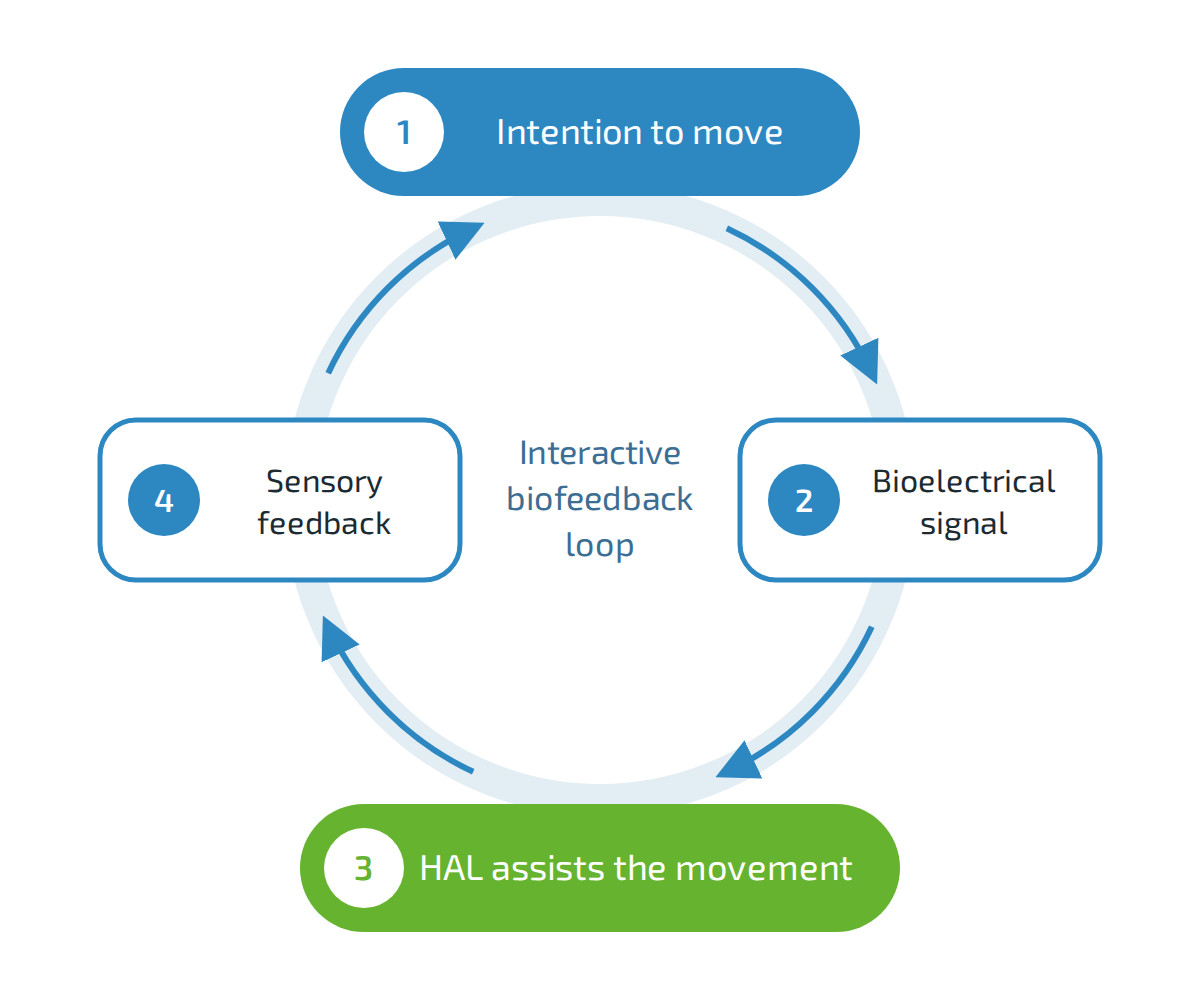
Through the electrical signal your nervous system sends to the muscle. Before a muscle visibly contracts, that signal can be detected at the surface of the skin, even when the resulting movement is too weak to see or is largely absent. Surface sensors pick up this bioelectrical signal and interpret it as your intended movement.[1]
Why should assisted movement change anything?
Because it closes a loop between intention, movement and feedback. HAL was developed on the basis of the interactive biofeedback hypothesis: the device assists the movement you are already attempting, so that the movement actually occurs. This generates real sensory feedback from muscle spindles and joint receptors, which travels back to the central nervous system.[2]
The hypothesis is that repeating this loop over many sessions reinforces the neural pathways involved — a form of activity-dependent neuroplasticity. This is a proposed mechanism under research, not an established effect for any individual, and it depends on enough residual signal being present for the loop to work at all.
One external study supports this picture directly. In subacute stroke patients, a single session of HAL-assisted training produced a measurable increase in activity in the primary motor cortex of the affected hemisphere, measured with functional near-infrared spectroscopy. The number of movements patients could perform also increased.[3] These are preliminary findings in a small group.
What do the studies show for ALS and MND?
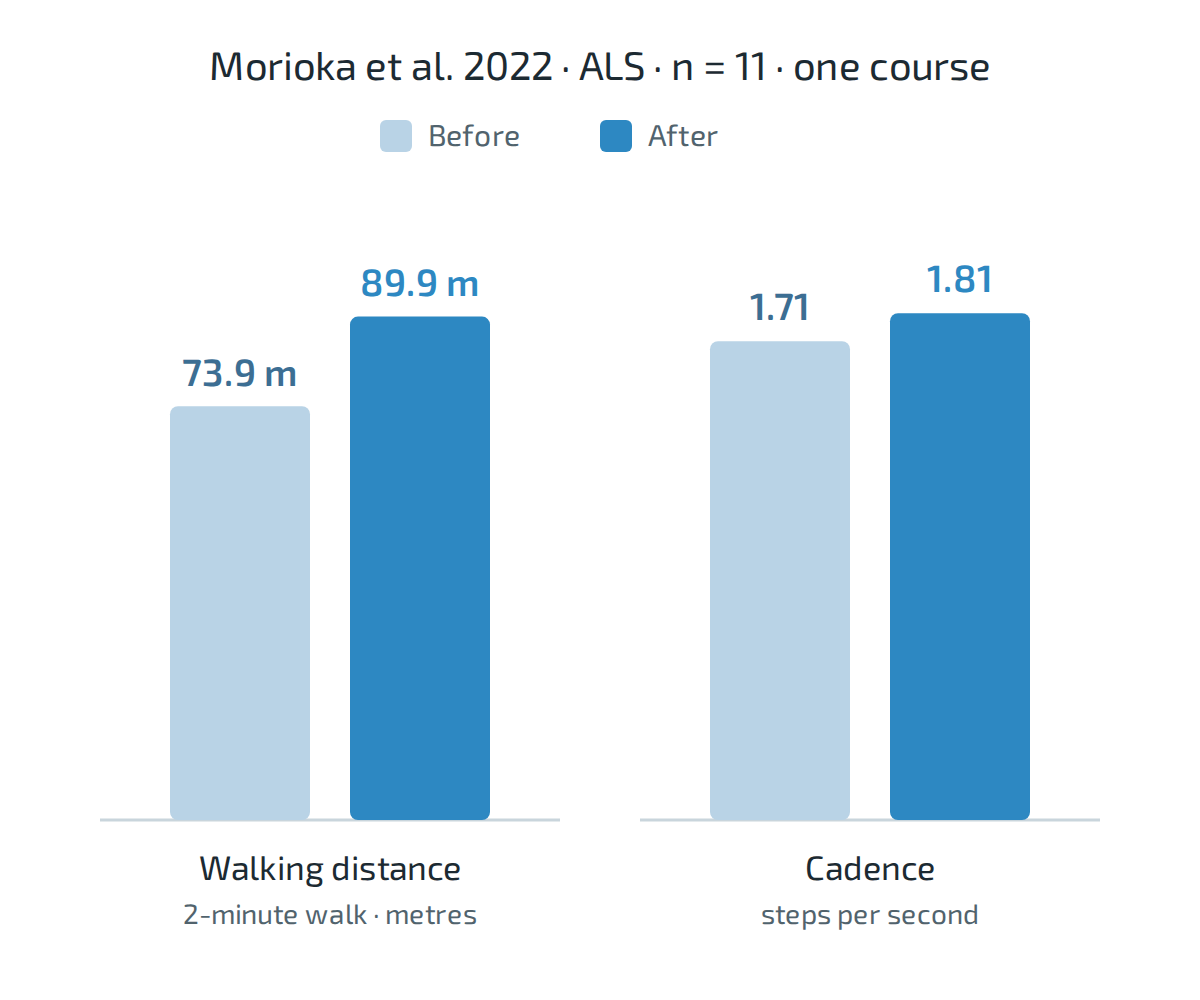
One improvement reached significance, others did not. In a small external ALS study, a full course of HAL training significantly improved gait cadence on the 10-metre walk test. Overall gait speed and step length did not change significantly in the same group.[5]
An external multicentre randomised controlled crossover trial across nine Japanese hospitals found that HAL-based cybernic treatment improved ambulatory function in patients with slowly progressive rare neuromuscular diseases, a category that includes ALS.[4]
A separate long-term follow-up with three courses in three patients found that the cadence gain persisted (p = 0.02). The gain in two-minute walking distance did not reach significance over the longer term (p = 0.21).[5] We show both, because what did not hold up matters as much as what did.
What is known outside ALS?
The wider evidence is real but still developing. In limb-girdle muscular dystrophy, a small external study found HAL-supported treadmill therapy safe and feasible.[6] In stroke rehabilitation, external studies of HAL-assisted gait training have reported improvements in walking function.[3],[7]
Sample sizes are generally small, not every outcome measure improves significantly, and results in one condition do not automatically transfer to another.
Who is eligible for HAL training?
Ambulatory patients who retain enough residual muscle activity for the sensors to detect a usable signal. Without a detectable signal the device cannot work as intended. Suitability is assessed individually: first as part of the clinical evaluation at ANOVA IRM, then at the initial assessment in Bochum, where it is checked whether the signal is strong enough for the device.
What does a course of HAL training look like?
It is built in three steps, and each step decides whether the next one makes sense. The training takes place at Cyberdyne Care Robotics in Bochum, which runs the centre for neurorobotic movement training; we coordinate it with your programme at ANOVA IRM.
- 01
Step 1 — initial assessment in Bochum
It is checked whether a usable residual signal is present and whether training has a realistic chance in your case.
- 02
Step 2 — four weeks of training
If there is no clear improvement in this phase, the course is stopped.
- 03
Step 3 — two further months
The training continues only if step 2 showed a clear improvement.
Published studies in comparable conditions have also used multi-week courses of repeated sessions rather than a single visit.
How is HAL training combined with MSC secretome therapy?
The two run in parallel, and the sequence is set by the production time of the secretome. Patients usually start with the mini-liposuction. During the four weeks of cell culture and European Pharmacopoeia quality control, HAL training begins.
- MSEC therapy then starts with two intrathecal doses.
- After that, one intrathecal dose follows roughly every two weeks, planned individually, until the 10 doses are used up.
- For a longer course, a double liposuction can be performed. It yields 20 doses, which can then be given over the three months of training or beyond.
In spinal cord injury the programme with HAL runs for three months. Without HAL the duration is set individually; please discuss it with your physician. The schedule for each condition is described on the SCI page and the ALS page.
What does HAL training cost?
HAL training costs approximately €10,000 to €30,000. A session costs about €500, and training usually runs five sessions per week, so the total depends on how far the course runs: the initial assessment alone, the four-week phase, or the full course with the two additional months. Your care coordinator provides a written estimate before each step.
Like the other experimental components of a programme, HAL training is generally self-funded; you can still ask your insurer about possible reimbursement.
Frequently asked questions
Is HAL training a treatment for ALS or MND itself?
No. HAL training does not treat the underlying disease process. It is an optional adjunct for ambulatory patients with enough residual muscle activity, alongside — not instead of — the core components of the programme.
Does HAL training replace physiotherapy?
No. HAL training is robot-assisted training that may complement conventional physiotherapy. It is not intended to replace standard rehabilitative care.
Does HAL training hurt?
HAL training is a form of physical training, and it is not a procedure: nothing is injected and nothing is implanted. You wear the exoskeleton and move with its assistance, so the effort is comparable to supervised gait training.
Is HAL training an established therapy in ALS or MND?
As an adjunct in rehabilitation, it is under investigation. The external ALS study showed a significant gain in cadence, while other gait measures did not change significantly.[5] It is not an approved treatment for ALS.
Is HAL training an established therapy in spinal cord injury (SCI)?
In SCI, HAL is part of our programme and is used internationally in neurorehabilitation, for example in gait training after incomplete injury. Whether it changes the course of the condition is not established. How it fits into the SCI programme is described on the SCI page.
Is HAL training an established therapy in multiple sclerosis (MS)?
In MS, HAL is an optional part of our programme. A small external pre-post study in 13 people with MS reported better step length, knee range of motion and EDSS scores after a two-month course; there was no control group. Whether HAL changes the course of MS is not established. How it fits into the MS programme is described on the MS page.
Where does HAL training take place?
At Cyberdyne Care Robotics in Bochum, about two hours from Offenbach. We coordinate the appointments with the visits for your programme at ANOVA IRM.
How many HAL sessions do I need?
That is decided step by step. After the initial assessment the first phase runs for four weeks; if it brings a clear improvement, two further months follow. You can read what other patients report in our testimonials and in the research news blog.
Important Pages
Questions people usually ask next. Each is answered in full on its own page.
- Who are we?
- Is ANOVA legal?
- Is stem cell therapy safe?
- What is MSC secretome (MSEC)?
- What is BMC (Bone Marrow Concentrate)?
- What are stem cells?
- What should I ask when looking for a stem cell treatment?
- Which conditions do we treat?
- The ANOVA ALS/MND programme
- The ANOVA MS programme
- How does intrathecal application work?
Affiliations of ANOVA
ANOVA IRM shares its premises in Offenbach with two further institutions owned by Dr. Stehling: the Institut für Bildgebende Diagnostik (IBDO), providing MRI and CT imaging, and the Vitus Prostate Center. Because imaging is carried out in the same building, condition-specific diagnostics — including CT-guided procedures — are performed in-house rather than referred elsewhere. See diagnostics at ANOVA IRM.
References
- [1] Sankai Y. HAL: Hybrid Assistive Limb based on cybernics. Robotics Research. 2010:25–34.
- [2] Morishita S, Inoue T. Interactive biofeedback and neuronal network reorganisation. 2016.
- [3] Saita K, Morishita T, Hyakutake K, et al. Biofeedback effect of hybrid assistive limb in stroke rehabilitation: a proof-of-concept study using fNIRS. PLOS ONE. 2018;13(1):e0191361.
- [4] Nakajima T, Sankai Y, Takata S, et al. Cybernic treatment with wearable cyborg HAL improves ambulatory function in patients with slowly progressive rare neuromuscular diseases: a multicentre, randomised, controlled crossover trial (NCY-3001). Orphanet J Rare Dis. 2021;16(1):304.
- [5] Morioka H, Hirayama T, Sugisawa T, et al. Robot-assisted training using hybrid assistive limb ameliorates gait ability in patients with amyotrophic lateral sclerosis. J Clin Neurosci. 2022;99:158–163.
- [6] Sczesny-Kaiser M, Kowalewski R, Schildhauer TA, et al. Treadmill training with HAL exoskeleton — a novel approach for symptomatic therapy in patients with limb-girdle muscular dystrophy — preliminary study. Front Neurosci. 2017;11:449.
- [7] Watanabe H, Goto R, Tanaka N, et al. Effects of gait treatment with a single-leg hybrid assistive limb system after acute stroke: a non-randomised clinical trial. Front Neurosci. 2019;13:1389.